
Monday, March 31, 2008
Urban PARKing Day
Last year I posted on how much I liked the idea of urban PARKing after watching a film at the Bicycle Film Festival. Well today i got to do it as an April 1 'Fossil Fools' day event. Thanks to some inspired minds from UNSW's enviro collective, we packed up some turf and trees and loaded them onto our bike trailers to take over one car parking space on King St, Newtown. We paid for the spot of course. We attracted a lot of attention and onlookers were very supportive. Urban spaces don't have to be made just for cars!


Friday, March 28, 2008
Highland fling
Day One: Campbelltown to Moss Vale
On Wednesday last week I had a wisdom tooth taken out. With nothing much to do I decided erratically to pack a few things and hit the road. My plan was to scout out the Southern Highlands. Not wishing to bash though Sydney’s traffic I took the train to Campbelltown then headed out along Menangle Road towards Picton. It was amazing to be riding in the middle of the country only a few minutes from Campbelltown. From Picton I followed the Old Hume Hwy down through Tahmoor and Bagro, then I accidentally turned onto Freeway at Catherine Hill before turning back on to the Old Hume to follow my way around the back on Mittagong and Borwal and onto Moss Vale. I had one flat and a weird defect with rear tire. A large air bubble emerged under one of the layers of the tire to the point that it was catching the break callipers. Eventually it popped and thankfully not the tube but I did get a puncture a few kilometres down the road. I was initially thinking of heading down to Bundanoon to stay at the Youth Hostel but it was getting dark so I pulled in at the Jemmy Moss Inn in Moss Vale. To my delight, the Inn was great value at $30 a night and the food and the atmosphere in the pub was excellent.
 (Rail bridge near Menangle)
 (Argyle Street, Picton)
 (Rural scene from Remembrance Drive/Old Hume Hwy)
Day Two: Moss Vale to Gerringong
I started day 2 at the Il Pranzo café in the mall at Moss Vale. It's by far the best café in the town and they roast the coffee beans on site. I then headed over to Legend Cycles to buy a new rear tire. Eventually at 10am I headed out of town along the Illawarra Hwy then turned right onto Nowra Rd towards Fitzroy Falls. The morning was overcast and very cold and I was fully rugged up with my cycling jacket on. From Fitzroy Falls there was a sharp decent into Kangaroo Valley which involved a lot of breaking. Just before you enter the township of Kangaroo Valley, I passed the Barrengarry Old Store and Post Office that claims to be “The Home of the Worlds Best Pies”. I stopped to try this claim out and I wasn’t disappointed. I avoided stopping at Kangaroo Valley as it looked to be one of those towns that is just full of boring tourist shops. From then it was across the valley then to a sharp climb over Berry Mountain. Halfway up the climb there was fridge on the side of the road that contained a self service fudge shop. From then, there was a lot more climbing then eventually I started to roll down the hill and into the town of Berry. I stopped for a quick feed at the Bakery then pushed on. Berry also appeared to me as one of those charmless town full of various shops dedicated to over-priced kitchen utensils and antiques. I took right turn not far out of town past the hospital then headed directly east along Beach Road towards Gerroa. The road coming into Gerroa was the only part of my entire ride where the traffic was quiet heavy and there wasn’t a very good shoulder to ride on. Finally, there was a steep hill up to Gerringong and the I headed straight to the station to get train back to Sydney.
 (Canal at Fitzroy Reservoir)
 (View back up to Fitzroy Falls)
 (Historic Bridge at Kangaroo Valley)
 (Kangeroo Valley)
 (Berry)
 (Gerroa)
Each day was approximately 75km of riding which took around 3.5 hours to complete. I’d ended up rushing things because I had to get back to Sydney on Friday night, but I still had a most enjoyable 2 days of riding. Next time I hope to get the week off.
On Wednesday last week I had a wisdom tooth taken out. With nothing much to do I decided erratically to pack a few things and hit the road. My plan was to scout out the Southern Highlands. Not wishing to bash though Sydney’s traffic I took the train to Campbelltown then headed out along Menangle Road towards Picton. It was amazing to be riding in the middle of the country only a few minutes from Campbelltown. From Picton I followed the Old Hume Hwy down through Tahmoor and Bagro, then I accidentally turned onto Freeway at Catherine Hill before turning back on to the Old Hume to follow my way around the back on Mittagong and Borwal and onto Moss Vale. I had one flat and a weird defect with rear tire. A large air bubble emerged under one of the layers of the tire to the point that it was catching the break callipers. Eventually it popped and thankfully not the tube but I did get a puncture a few kilometres down the road. I was initially thinking of heading down to Bundanoon to stay at the Youth Hostel but it was getting dark so I pulled in at the Jemmy Moss Inn in Moss Vale. To my delight, the Inn was great value at $30 a night and the food and the atmosphere in the pub was excellent.
 (Rail bridge near Menangle)
 (Argyle Street, Picton)
 (Rural scene from Remembrance Drive/Old Hume Hwy)
Day Two: Moss Vale to Gerringong
I started day 2 at the Il Pranzo café in the mall at Moss Vale. It's by far the best café in the town and they roast the coffee beans on site. I then headed over to Legend Cycles to buy a new rear tire. Eventually at 10am I headed out of town along the Illawarra Hwy then turned right onto Nowra Rd towards Fitzroy Falls. The morning was overcast and very cold and I was fully rugged up with my cycling jacket on. From Fitzroy Falls there was a sharp decent into Kangaroo Valley which involved a lot of breaking. Just before you enter the township of Kangaroo Valley, I passed the Barrengarry Old Store and Post Office that claims to be “The Home of the Worlds Best Pies”. I stopped to try this claim out and I wasn’t disappointed. I avoided stopping at Kangaroo Valley as it looked to be one of those towns that is just full of boring tourist shops. From then it was across the valley then to a sharp climb over Berry Mountain. Halfway up the climb there was fridge on the side of the road that contained a self service fudge shop. From then, there was a lot more climbing then eventually I started to roll down the hill and into the town of Berry. I stopped for a quick feed at the Bakery then pushed on. Berry also appeared to me as one of those charmless town full of various shops dedicated to over-priced kitchen utensils and antiques. I took right turn not far out of town past the hospital then headed directly east along Beach Road towards Gerroa. The road coming into Gerroa was the only part of my entire ride where the traffic was quiet heavy and there wasn’t a very good shoulder to ride on. Finally, there was a steep hill up to Gerringong and the I headed straight to the station to get train back to Sydney.
 (Canal at Fitzroy Reservoir)
 (View back up to Fitzroy Falls)
 (Historic Bridge at Kangaroo Valley)
 (Kangeroo Valley)
 (Berry)
 (Gerroa)
Each day was approximately 75km of riding which took around 3.5 hours to complete. I’d ended up rushing things because I had to get back to Sydney on Friday night, but I still had a most enjoyable 2 days of riding. Next time I hope to get the week off.
Sunday, March 23, 2008
Tread Lightly
My touring aspirations have moved one step closer this week as the task of adapting my old road bike into a ‘light tourer’ is now complete. The first thing I did was put a ‘deore’ rear derailleur and cassette giving me much more hill climbing capabilities. Then there was the arrival of the new Carridice Super C Frontbag and to finish it off, I’ve bought a lovely new Brooks B-17 saddle. I’ve heard a lot of talk about the famous B-17. Some people swear by them, others hate em, or profess that the wearing in period is a very long and painful process. I strongly contest this argument. From just spending the whole day on the road, I found the B-17 comfortable from the very beginning. It’s a very smooth and well shaped saddle suited for a relaxed riding position.
 I took the new rig out today for a meandering 65km ride from Windsor up to Sackville ferry and back via the Cattai National Park. Everything ran very smoothly although the derailleur is a little jumpy (perhaps a minor barrel adjustment?). I’m aiming to do quiet a few loaded rides around Sydney in the next week as I’m planning to go bush sometime next week. I’m thinking maybe Victoria?
 To go with the cycle touring scheme, I’ve also recently purchased a cyclist flap-hat. Harking back to the late 80s when fluro flap-hats were all the rage, I’m now reliving my youth as a more sun-smart late 20 something.
 I took the new rig out today for a meandering 65km ride from Windsor up to Sackville ferry and back via the Cattai National Park. Everything ran very smoothly although the derailleur is a little jumpy (perhaps a minor barrel adjustment?). I’m aiming to do quiet a few loaded rides around Sydney in the next week as I’m planning to go bush sometime next week. I’m thinking maybe Victoria?
 To go with the cycle touring scheme, I’ve also recently purchased a cyclist flap-hat. Harking back to the late 80s when fluro flap-hats were all the rage, I’m now reliving my youth as a more sun-smart late 20 something.
Sunday, March 16, 2008
Mellow Yellow
I have a new fixie and its yellow.
 Its not really new but all the parts from my old Apollo have been swapped onto this frame. The the old bike has a slightly skewed rear triangle which made it impossible to straighten the rear wheel with good chain tension. The other advantage of the new frame is that its slightly smaller and fits me perfectly. I'm a big fan of the colour yellow. Its highly vissible on the road and has something upbeat and playful about it. As I was photographing the bike, my cat Augie decided to come and say hello... although he didn't seem to be too interested in the bike, only snoozing and having his belly scratched.
 So, in honour of Augie, I think I'll name this bike:

 Its not really new but all the parts from my old Apollo have been swapped onto this frame. The the old bike has a slightly skewed rear triangle which made it impossible to straighten the rear wheel with good chain tension. The other advantage of the new frame is that its slightly smaller and fits me perfectly. I'm a big fan of the colour yellow. Its highly vissible on the road and has something upbeat and playful about it. As I was photographing the bike, my cat Augie decided to come and say hello... although he didn't seem to be too interested in the bike, only snoozing and having his belly scratched.
 So, in honour of Augie, I think I'll name this bike:
Saturday, March 08, 2008
Pedestrian psychopath ahead
 I had a really freaky experience on Saturday working as a Route Marshall at the “Gear Up Girl” women’s cycling event. The event was the first all women’s bike ride to celebrate International Women’s Day. I spent a good part of the morning directing women cyclists along he shared cyclepath/ pedestrian walkway at Brighton Le Sands. As they passed, I asked them slow down and watch for pedestrians as they negotiated the shared part of the course. During the day a man with a pram walked up to me in a screaming rage and threatened to hit me. The altercation went something like this:
Crazy man: “Why aren’t these cyclists keeping to the left!”
Me: “Sir, I’m asking them to slow down and watch out for pedestrians as they pass”.
Crazy man: “This is dangerous, we have children walking along here… who is responsible for this?”
Me: “Sir, this is an event run by Bicycle NSW, we have a traffic management plan that is approved by the RTA and the police, we're trying to make this safe for everybody.”
[the crazy man then walks away then turns back towards me clenching his fists threatening to hit me]
Crazy man: “You fucking smart arse, I outta punch you in the head”.
[I stepped back away from him]
Crazy man; [Screaming] “You fucking cyclists, I’ve seen you in the city, you run the red lights, you break all the road rules, you’re fucking hypocrites... hypocrites."
[Crazy man finally walks away].
This altercation scared the crap out of me. I’ve had bad run-ins with motorists trying to run me off the road, but I’d never had a pedestrian abuse me in this way (and I wasn’t even on my bike). Now I know that the man had a pram and probably had some hard-wired nurturing instinct to protect his young from any real or perceived danger, but his reaction was completely over the top. There were signs everywhere saying there was a cycling event on, and the women were not exactly floggin it along the cycleway. I was astounded by the way the man quickly turned his line of reasoning from some moral indignation about safety to broad speaking hatred of all cyclists as “fucking hypocrites”. I wonder, does this man own a bike or have ever or have ridden one? Does anybody in his family own a bike? Do any of his work colleagues or friends consider themselves “cyclists”? If I was a real smart arse, I would have told him:
"Sir, do you think it is interesting that bicycles have outsold cars for the last 7 years in a row?"
To witness such pathological behaviour is understandable and I’ve felt similar outrage when I’ve felt like I was going to be killed by a motorist. I’ve wanted to blow my top, but I usually control my anger and not blow up. I do feel sorry for pedestrians who used shared cycleway/footpaths. They can be dangerous and not all cyclists are sensible they way they ride around on them. However there are risks everywhere in our society. It seems that cyclists find themselves to be “betwixt and between”. Somehow “we” find ourselves as illegitimate users of both spaces. Within some quasi-democratic-spatial imaginary, going for a walk and driving a car holds resonance as legitimate social activities, but supposedly cyclists go about their ways as vile law-breaking monsters.
Tuesday, February 26, 2008
Adaptive reuse for bicycles
Adaptive reuse is the design principle by which old structures take on new purposes.
What does this mean for bicycles? Well, the majority of urban spaces since the 1950s have been built around the idea that all forms of transportation would be undertaken by cars. Getting rid of this dogma allows one to see that old spaces can be recreated in new ways that suport cycling as an everyday form of transportation.
 Sometimes all you need is a bit of brain power and a can of paint.
What does this mean for bicycles? Well, the majority of urban spaces since the 1950s have been built around the idea that all forms of transportation would be undertaken by cars. Getting rid of this dogma allows one to see that old spaces can be recreated in new ways that suport cycling as an everyday form of transportation.
Consider the following picture of the "Cycle Central" facility at Manly Council. By taking 5 carparking spaces away from cars, the council was able to provide secure bike parking facilities for 72 cyclists. This ratio works at roughly 1 carparking space to every 14 bicycles meaning that the problem of traffic congestion may require less carparking rather than more.
 Building cycleways can also be seen as a complex and expensive process. However, here at Hallstrome Reserve Willoughby, the council has simply moved the carparking spaces 1.5 metres across to facilitate a more direct cycleway access through the area.
Sometimes all you need is a bit of brain power and a can of paint.Saturday, February 09, 2008

Thursday, January 31, 2008
Tuesday, January 29, 2008
Sunday, January 27, 2008

Saturday, January 19, 2008


Friday, January 18, 2008
Tuesday, January 15, 2008
Touring modifications
I've finally modified my (old) road bike in a way that suites my current riding which is mostly for travel and commuting. Of course, this has just been one big incentive to finally bite the bullet and get a new road bike for racing. The most important thing I've done was to put a slightly higher and shorter stem on the bike to encourage a more relaxed touring geometry. After that, I've rebuilt my rear wheel with a Velocity Deep V rim for strength and durability. My old rims had cracks from being trued one too many times. The next stage in the evolution was to get a Carridice SQR Tour Saddlebag – something that I've become very fond of. No more sweaty backpacks! For a full review of the saddlebag, check out my post at Sydney Cyclist. The road bike is not ideal for serious touring as the geometry is a bit twitchy and not really suited for heavy loads, but for light touring it works just fine.
Monday, January 14, 2008
Headstart For Happiness
Over the last week, Mr Alan Evans of the NRMA started an amazing debate with cyclists around the under-use of a cycleway facility that wasn't even completed. There were many letters replying in the Herald, some pro - cycling articles, Clover Moore got into the debate, then Lisa Prior described Alan's remarks as the 'cyclist's oyster... providing the grit for cultural change', then there was more media coverage on the news and on radio talkback, and suprise, suprise... most of it has been very positive for cyclists leaving the car lobby choking on its own fumes. Alan even tried to patch things up with a more considered reply in the Herald. According to Alan, the Epping Rd cycleway will not be a nirvana for cyclists. Thats ok Alan, cyclists don't need to go to nirvana, but the last time I rode along Epping Road it sure didn't look like a nirvana for motorists.
All the roads that lead to struggles
Bring you back to where you need
Some reassurance in your own depth,
Only you can see, but let others feel
Peace in my mind i'm so happy to find
As i get on my trek with a headstart back to you.
Anyway, yesterday I did something I havn't done for a while – I drove a car. As I'm moving houses I find them very useful sometimes. As I drove between Redfern and Burwood I saw cyclists everywhere in vast numbers. Seeing so many peddlers gave me a sense of joy and bliss. We're winning... Thanks Alan, this song is dedicated to you...
All the roads that lead to struggles
Bring you back to where you need
Some reassurance in your own depth,
Only you can see, but let others feel
Peace in my mind i'm so happy to find
As i get on my trek with a headstart back to you.
Friday, January 11, 2008

Thursday, January 10, 2008
Thursday, January 03, 2008
Pedaling some thoughts
While cycling is often considered to be a form of physical exercise, I often find it to be more of a place where I do a lot of thinking and relaxing. Some people head off to yoga classes after work. I just jump on the bike. In both cases the increased flow of blood through the body can awaken the mind and senses. The bike is one of the few places in my life in which I have almost no distractions – there is no radio or TV soundscape, no work colleagues or flatmates to bump it to, its just me and the road ahead. While I’m aware of the traffic around me there is an preconscious dimension of cycling in which you control the bike and react to your environment without having to think. This leaves plenty of time just to relax and think about other things like this.
Several years ago I remember hearing a lecture by Professor Peter Newman on the importance of transport in terms of reflective time. He talked about the Marchetti constant which is the time budget we give ourselves to moving each day. The idea is that we have a time budget of around an hour each day and our transport habits are almost always structured within this period. According to Newman:
In Sydney, it would seem that many people have extended themselves well beyond the 1 hour limit of the Marchetti constant. Somewhere there is a tipping point from which the enjoyable ‘time out’ of transportation had moved into a negative territory of stress and frustration. Is it any wonder people can become so hot headed about being stuck in traffic or on having to wait for public transport? Car designs have capitalised on these dilemmas but turning into mobile living rooms with amazing sound systems, computers and other electronic devices to be distracted with. If Newman is correct in identifying the centrality of the Marchetti constant, then one the main concerns of transport planning should be on providing a quality experience of time within the limits of say 30mins. As bicycles engage the body in an active way, they are surely a winner in this regard as a from of stress free transportation. But not everyone sees it this way. Cycling is always regarded by non-cyclists as too hard and too dangerous.
Perhaps, the critical issue for promoting cycling then should be making it more enjoyable. This shouldn't be done by fantasizing about a city with bicycle lanes like Copenhagen, but by equipping urban spaces in a way that normalizes cycling as an everyday activity. Of course we need an improved bicycle lane network, but this is only one part of the equation. We need to do other things like changing the design of buildings. Think about what happens when you build a flat building. There is usually a giant underground carpark but no space for bicycles. You can be caught having to carry your bicycle up four flights of stairs when there could be a secure communal bicycle depot on the ground floor. At the workplace, the train station or shopping mall, if there are even any bicycle racks they are often hidden in poorly accessible places where they are more likely to be stolen. If your lucky and your workplace has a shower , it probably won't have a locker. Many cyclists are often afraid of wanting more infrastructure (particularly bike lanes) because those who already cycle have already ‘evolved’ to the environment and have seen how all the positives overcome some setbacks. This may be good for us, but what about everyone else? What will be their tipping point?
If comfort is one important part of the Marchetti constant, then time and space (urban geography) must be the other dimension. While one may enjoy riding a bike or catching public transport within certain times and spaces, clearly such means of transportation can be inadequate for many others. Consider if one is living in Blacktown and working in Manly. Its easy for cyclists to moralise against dilemmas by saying that all people should simply move closer to their place of employment, but such claims seem to be oblivious to the complex matrix of labour markets, housing and wealth that structure Sydney’s social geography. In my mind, more equitable housing policy could be the elephant within the room of the wider sustainable transport debate. It doesn’t strike me as a mere coincidence that cities and countries which strong cycling cultures (Denmark, Holland, Germany) also happen to be the ones that have more equitable forms of housing policy. Repositioning housing in more equitable ways can allow for different experiences of transportation and mobility within the city. For many years the 'solution' to housing affordability has been to build cheap houses out in the autopic suburban fringe, while in the inner city, urban consolidation policies have often been touted as the solution in terms of sustainability. However, there little evidence that urban consolidation has done anything in terms of providing housing equity catering mostly for the young, rich and cosmopolitan. It seems to me that the sustainable transport debate needs to move beyond its focus on different transport modes, and come to consider what are the everyday and varied time-spaces that we inhabit as different people who move across the city.
Several years ago I remember hearing a lecture by Professor Peter Newman on the importance of transport in terms of reflective time. He talked about the Marchetti constant which is the time budget we give ourselves to moving each day. The idea is that we have a time budget of around an hour each day and our transport habits are almost always structured within this period. According to Newman:
The reality is that you need about an hour a day as a reflective restorative time. It seems to be a biological principle. This is a real limit to how we build cities, because what it shows is that cities are one-hour wide everywhere. Walking cities will be only five to eight kilometres across. The early pictures of Sydney right through the 19th century show that. The transit city - and you had a picture up to 1947 with a city that was about 20 or 25 kilometres across - this is still the one- hour wide city, with the trams and trains taking people further out…. The automobile cities which we have been building for the past 50 years could spread 50 to 60 kilometres and still be within that one-hour wide city.
In Sydney, it would seem that many people have extended themselves well beyond the 1 hour limit of the Marchetti constant. Somewhere there is a tipping point from which the enjoyable ‘time out’ of transportation had moved into a negative territory of stress and frustration. Is it any wonder people can become so hot headed about being stuck in traffic or on having to wait for public transport? Car designs have capitalised on these dilemmas but turning into mobile living rooms with amazing sound systems, computers and other electronic devices to be distracted with. If Newman is correct in identifying the centrality of the Marchetti constant, then one the main concerns of transport planning should be on providing a quality experience of time within the limits of say 30mins. As bicycles engage the body in an active way, they are surely a winner in this regard as a from of stress free transportation. But not everyone sees it this way. Cycling is always regarded by non-cyclists as too hard and too dangerous.
Perhaps, the critical issue for promoting cycling then should be making it more enjoyable. This shouldn't be done by fantasizing about a city with bicycle lanes like Copenhagen, but by equipping urban spaces in a way that normalizes cycling as an everyday activity. Of course we need an improved bicycle lane network, but this is only one part of the equation. We need to do other things like changing the design of buildings. Think about what happens when you build a flat building. There is usually a giant underground carpark but no space for bicycles. You can be caught having to carry your bicycle up four flights of stairs when there could be a secure communal bicycle depot on the ground floor. At the workplace, the train station or shopping mall, if there are even any bicycle racks they are often hidden in poorly accessible places where they are more likely to be stolen. If your lucky and your workplace has a shower , it probably won't have a locker. Many cyclists are often afraid of wanting more infrastructure (particularly bike lanes) because those who already cycle have already ‘evolved’ to the environment and have seen how all the positives overcome some setbacks. This may be good for us, but what about everyone else? What will be their tipping point?
If comfort is one important part of the Marchetti constant, then time and space (urban geography) must be the other dimension. While one may enjoy riding a bike or catching public transport within certain times and spaces, clearly such means of transportation can be inadequate for many others. Consider if one is living in Blacktown and working in Manly. Its easy for cyclists to moralise against dilemmas by saying that all people should simply move closer to their place of employment, but such claims seem to be oblivious to the complex matrix of labour markets, housing and wealth that structure Sydney’s social geography. In my mind, more equitable housing policy could be the elephant within the room of the wider sustainable transport debate. It doesn’t strike me as a mere coincidence that cities and countries which strong cycling cultures (Denmark, Holland, Germany) also happen to be the ones that have more equitable forms of housing policy. Repositioning housing in more equitable ways can allow for different experiences of transportation and mobility within the city. For many years the 'solution' to housing affordability has been to build cheap houses out in the autopic suburban fringe, while in the inner city, urban consolidation policies have often been touted as the solution in terms of sustainability. However, there little evidence that urban consolidation has done anything in terms of providing housing equity catering mostly for the young, rich and cosmopolitan. It seems to me that the sustainable transport debate needs to move beyond its focus on different transport modes, and come to consider what are the everyday and varied time-spaces that we inhabit as different people who move across the city.
Friday, December 28, 2007
Sydney to Seal Rocks (or bike + one train and three ferries)
Every year I go camping with friends for the Christmas to New Years period. This year was no different, but this time I didn't have a car and so my challenge was to get to our campsite at Seal Rocks by whatever means possible. To get there, I used the Cycling Australia book put out by Lonely Planet. Its a great read for the cycle touring novice and it has excellent advice in choosing the safest and most scenic routes. For my mini tour of the east coast, I covered a distance of 180km that is usually done over three days but it was nice just to get a taste for touring. I started the morning at 6:30am and rode straight to Berowa train station. I would have caught the train from Straithfield, however there was trackwork on the Newcastle line and a bike unfriendly bus service running between Straithfield and Berowa.
 I arrived at Newcastle at around 11:30am and in no time I was on the ferry to Stockton. It only cost $1 to catch the ferry...
 ... and they great bike racks. From Stockton, I rode 50km along Nelson Bay Road to Nelson Bay. I was a bit anxious as to what the road would be like but it had an excellent shoulder. There was a lot of holiday traffic but no dramas.
 I arrived at Nelson Bay at around 1:30pm. I had an hour break with enough time to grab some fish and chips before catching the 2:30pm ferry to Tea Gardens.
  On the ferry, my bike was just tied onto the roof of the old boat. It was a bit more expensive costing $15, but was much more scenic.
 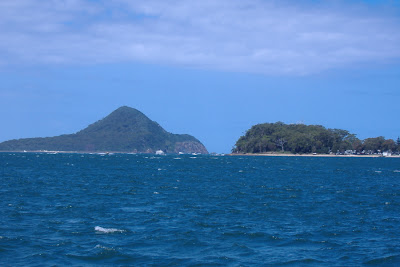 It took just on an hour to get across Post Stephens. There area is renown for Dolphin watching but I was unlucky to see any on the day.
 From Tea Gardens its a short ride to Myall Lakes National Park. On the map, there was a more direct walking track heading straight along the coast to Seal Rocks, but as I was on my road bike I took the more scenic route around the lakes.
 Another 30km along, I arrived at Bombah Point where I had to catch my third ferry of the day.
 From there, it was another 15km along a dirt road to the small highway town of Bulahdelah.
 At Bulahdelah, I was back on the Pacific Highway for a couple of kilometers then I took the Lakes Way Rd turn off to Seal Rocks. I misjudged how long this part of the ride would take me. It was another 40km to Seal Rocks with a few steep hills to keep me awake.
 I eventually got to Seal Rocks at 7pm. The town is amazingly quiet with only one cafe and a post office . I found the campsite around 7:30pm and was pleased to arrive as dinner was being made.
I think I've got the touring bug.
 I started the morning at 6:30am and rode straight to Berowa train station. I would have caught the train from Straithfield, however there was trackwork on the Newcastle line and a bike unfriendly bus service running between Straithfield and Berowa.
 I arrived at Newcastle at around 11:30am and in no time I was on the ferry to Stockton. It only cost $1 to catch the ferry...
 ... and they great bike racks. From Stockton, I rode 50km along Nelson Bay Road to Nelson Bay. I was a bit anxious as to what the road would be like but it had an excellent shoulder. There was a lot of holiday traffic but no dramas.
 I arrived at Nelson Bay at around 1:30pm. I had an hour break with enough time to grab some fish and chips before catching the 2:30pm ferry to Tea Gardens.
  On the ferry, my bike was just tied onto the roof of the old boat. It was a bit more expensive costing $15, but was much more scenic.
  It took just on an hour to get across Post Stephens. There area is renown for Dolphin watching but I was unlucky to see any on the day.
 From Tea Gardens its a short ride to Myall Lakes National Park. On the map, there was a more direct walking track heading straight along the coast to Seal Rocks, but as I was on my road bike I took the more scenic route around the lakes.
 Another 30km along, I arrived at Bombah Point where I had to catch my third ferry of the day.
 From there, it was another 15km along a dirt road to the small highway town of Bulahdelah.
 At Bulahdelah, I was back on the Pacific Highway for a couple of kilometers then I took the Lakes Way Rd turn off to Seal Rocks. I misjudged how long this part of the ride would take me. It was another 40km to Seal Rocks with a few steep hills to keep me awake.
 I eventually got to Seal Rocks at 7pm. The town is amazingly quiet with only one cafe and a post office . I found the campsite around 7:30pm and was pleased to arrive as dinner was being made.
I think I've got the touring bug.
Tuesday, December 18, 2007

Monday, December 10, 2007
Hello Apollo
The Apollo IV has finally launched off the ground. Here are some photos from my maiden voyage around Sydney Olympic Park this morning. The fixie is a lot of fun to ride but you have to think a lot more about what your doing. I've found it particularly fun on the uphills where despite a lack of gears, I seem to be able to generate a lot more speed as the momentum is kept spinning through the fixed wheel.

 I started this project with one thing in mind. To build a fixie for as little money as possible. I didn't quite get under my budget of $200, but I came very close. I've been grateful to have many people help out by giving me all the bits and pieces I needed and in Lindsay's amazing generosity in building it up for me. Here is the breakdown of the costs.
Frame: given (Chris)
Crankset: given (Chris)
Fork: given (Mike via Huw)
Headset: given (Lindsay)
Stem: given (Lindsay)
Drop bars: given (Lindsay)
Sprocket: given (Lindsay)
Front wheel: given (Lindsay)
Break hoods and callipers: given (Lindsay)
Seat post: given (Lindsay)
Saddle: owned
Pedals: owned
Track hub: $15 (an amazing bargain from Al Summers)
Velocity rear track rim: $90 (from Al Summers)
Tires: $80
Bottom bracket: $40
Chain: $25
Bar tape: $15
Lindsay’s work putting it all together: priceless
Total cost: $265
Update see : http://www.fixedgeargallery.com/

 I started this project with one thing in mind. To build a fixie for as little money as possible. I didn't quite get under my budget of $200, but I came very close. I've been grateful to have many people help out by giving me all the bits and pieces I needed and in Lindsay's amazing generosity in building it up for me. Here is the breakdown of the costs.
Frame: given (Chris)
Crankset: given (Chris)
Fork: given (Mike via Huw)
Headset: given (Lindsay)
Stem: given (Lindsay)
Drop bars: given (Lindsay)
Sprocket: given (Lindsay)
Front wheel: given (Lindsay)
Break hoods and callipers: given (Lindsay)
Seat post: given (Lindsay)
Saddle: owned
Pedals: owned
Track hub: $15 (an amazing bargain from Al Summers)
Velocity rear track rim: $90 (from Al Summers)
Tires: $80
Bottom bracket: $40
Chain: $25
Bar tape: $15
Lindsay’s work putting it all together: priceless
Total cost: $265
Update see : http://www.fixedgeargallery.com/
Tuesday, December 04, 2007
Cycle Park
One of my favorite films from the recent Bicycle Film Festival was put out by a group called Rebar. The group went around San Francisco taking over carparking spaces with temporary urban parks (all while paying the parking meters). You can see the full film here.
Sunday, December 02, 2007
Nov 30-Dec 2 - A Cycling Odyssey
This weekend has been amazing. There were cycling events happening everywhere showing the amazing diversity of cycling culture. Here are a few happy snaps from the weekend.
Friday night - Critical Mass Bridge Ride
 (Photo by Moz)

 I went back to the BFF on Saturday avro. I caught a few more films and had some fun helping out at the bicycle valet parking. There certainly were some interesting bikes on show. The rows of amazing bikes had become something of an event in itself and there were people crowding round the barriers just to look at them.
Sunday Morning
 I somehow managed to get out of bed on Sunday for my regular ride out to Waterfall with DHBC. I hadn't done it for a while, but it was great to get a solid 80kms in before breakfast.
Sunday Avro - World Track Championships

 After the Waterfall ride, I rode straight out to Dunc Gray Velodrome to watch the World Track Championships with Huw and Simon. It was the most impressive cycling I'd ever seen. I watched the finals of the women's Keiran, Mens sprints, the womens team pursuits and the amazing Madison final. Just amazing.
Friday night - Critical Mass Bridge Ride
 (Photo by Moz)
It was a pretty good turn out but not quiet as big as last year. I got to have fun towing the sound system trailer which had been lent to me for the evening. As we rolled into the middle of the bridge for a bike lift I was pleased to hear Jill Scott Heron's The revolution will not be televised pumped out of the sound system. After, that we headed out for dinner then onto the Bicycle Film Festival for more cycling madness. It was fun cruzin home at midnight with stero still pumping out tunes much to the amusement of many onlookers.
Saturday Avro: Bike Film Festival
Saturday Avro: Bike Film Festival
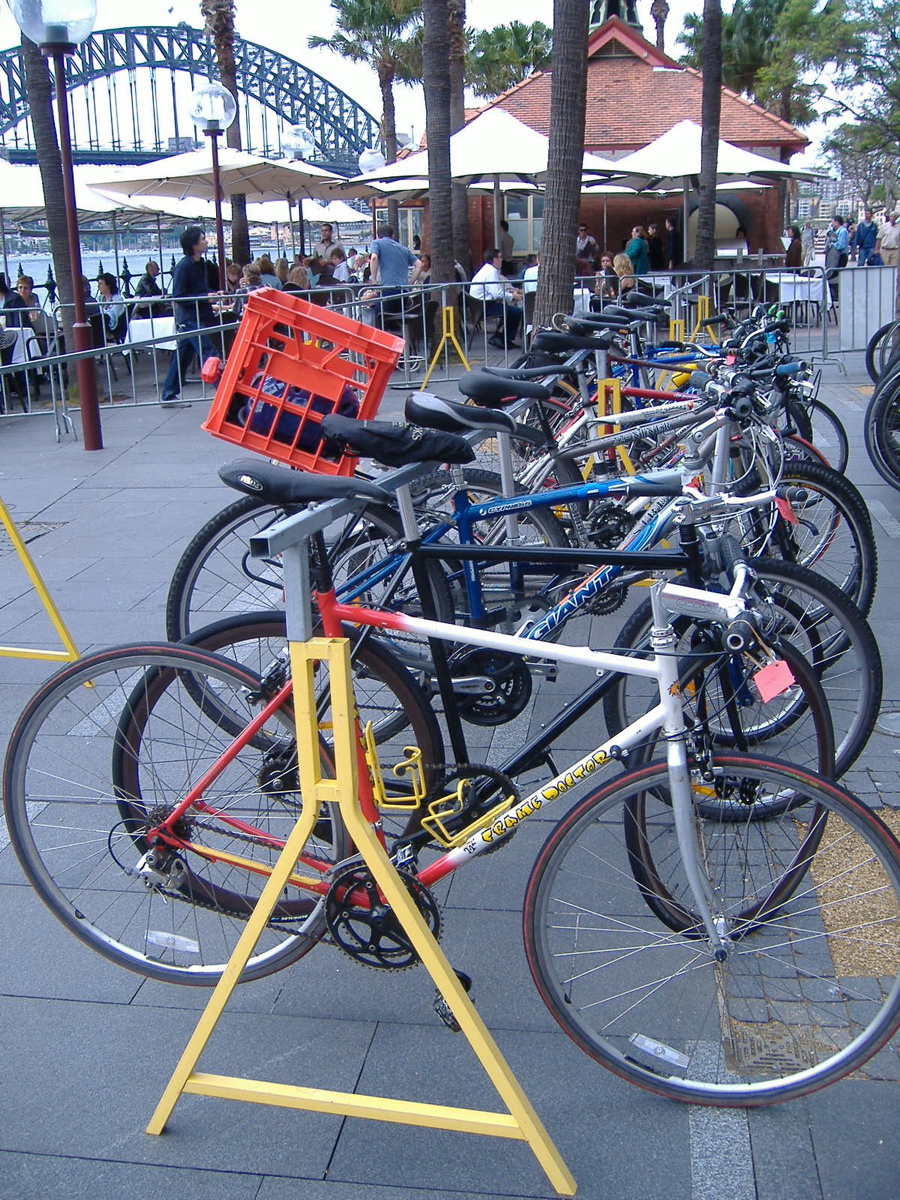
 I went back to the BFF on Saturday avro. I caught a few more films and had some fun helping out at the bicycle valet parking. There certainly were some interesting bikes on show. The rows of amazing bikes had become something of an event in itself and there were people crowding round the barriers just to look at them.
Sunday Morning
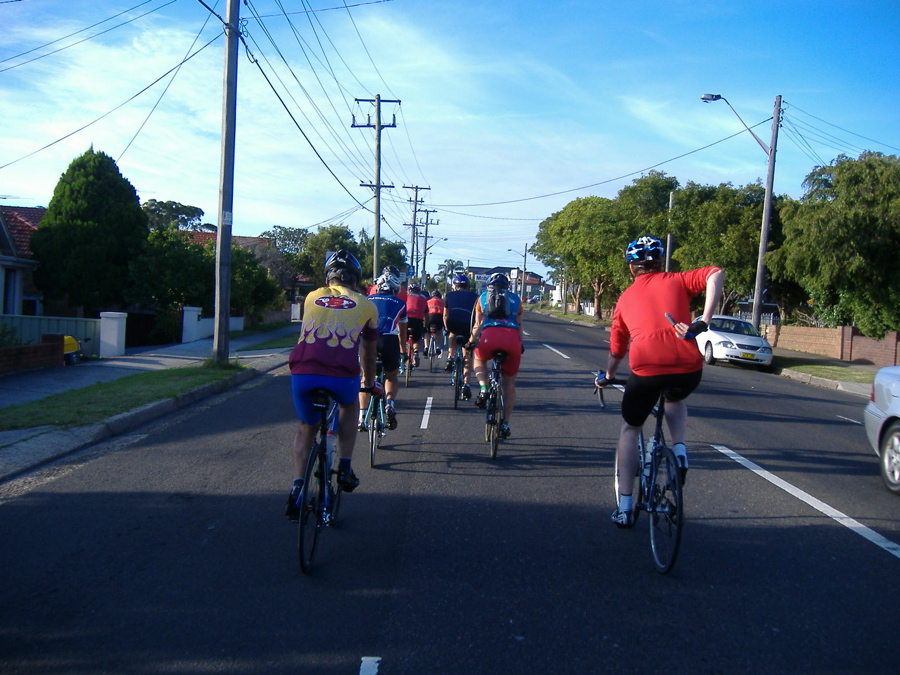 I somehow managed to get out of bed on Sunday for my regular ride out to Waterfall with DHBC. I hadn't done it for a while, but it was great to get a solid 80kms in before breakfast.
Sunday Avro - World Track Championships

 After the Waterfall ride, I rode straight out to Dunc Gray Velodrome to watch the World Track Championships with Huw and Simon. It was the most impressive cycling I'd ever seen. I watched the finals of the women's Keiran, Mens sprints, the womens team pursuits and the amazing Madison final. Just amazing.
Wednesday, November 28, 2007

Wednesday, November 21, 2007
Progress
I've spent the last two weeks trying to source bit and pieces for my fixie build. I've also given the frame a touch up with enamel spray paint. So far I've spent $55 all up and my aim it to build it for under $200 (what most fixianadros will pay for their brooks saddle). The biggest cost of all is going to be in the wheels.


Monday, November 19, 2007
The Road to Nowhere
I've finally spun out a paper around my interest in psychoanalysis and cars. Be very afraid!!! This is a draft. Any comments welcome.
The Road to Nowhere
Draft paper presented to Sydney Lacan Seminar, 17.11.07
Introduction
The idea for this paper developed rather mysteriously one night. I was riding my bike to my monthly Lacan seminar. As I speed down the hill an old silver Mercedes came up behind me and the driver started honking his horn. I was cycling at around 40km and hour, ten kilometres and hour less that the speed limit. As I rode, I pointed down to the painted image of the bicycle that was in the middle of the road. Despite this, the motorist continued to honk at me and drive right behind me in an aggressive manner. Eventually he speed past me. When I arrived at the seminar that night, I told my colleagues about this experience of road rage. I then joked with them about how I wanted to write a paper on the psychopathologies of motoring. As a former urban planner and something of a cycling advocate, I’ve spent a lot of time thinking about cars and roads, and I’ve my fair share of run-ins with angry motorists. However, when proposing the idea for this paper, I was surprised that my Lacanian colleagues would take me up on it. What could Lacan have to say about motoring? Yet, when I started looking through Lacan’s seminars I was also pleased to find that Lacan spent some time talking about roads and highways. However, as a novice reader of Lacan, I have not attempted to give a theoretically sophisticated account of these seminars. Rather, I have attempted to develop a few loose observations about how we may think about automobiles and roads via the detours of psychoanalysis and popular culture.
The Age of the Automobile
From the etymology, an ‘automobile’ is a machine that provides self-directed mobility. The development of the automobile proved revolutionary in the late nineteenth century, as it provided a means of independent transportation that was neither limited by the use of horses nor the construction of railway lines. However, what is most remarkable about the automobile is that despite being so commonplace in our society, its history is relatively short (indeed, no older than psychoanalysis). While the earliest experiments involving steam powered vehicles can be traced back as early as the 1860s, it was only in the 1890s that people began making the first petrol powered automobiles. At the turn of the century, automobiles were a craze for the well to do. Taken as a hobby for wealthy businessmen, the first automobile clubs developed in Europe and America primarily for the purposes pleasure such as recreational touring and car racing. However, during the course of the twentieth century, the automobile would quickly change from being a privileged commodity to an object of mass appeal and mass consumption.
In the last hundred years, it is estimated that over one billion cars have been manufactured (Urry 2005). The effects of automobiles would alter life in the most profound ways. The automobile would change our conceptions of time, space and subjectivity. In affluent societies, the automobile has become essential for both work and leisure. The automobile has made it increasingly possible for us ‘take our own roads’ in life. In this sense, the automobile encompasses many of the liberal values of freedom and individuality. The automobile has changed the surface of the earth through the development of highways and roads. This interconnecting of places has deeply affected many traditional forms of social, cultural and economic interaction. The automobile has made it possible for many people to adopt new forms of suburban life and to participate car based consumption. Not only have automobiles generated new freedoms to move to different places, they have also changed our understanding of ‘place’ though the production of autoscapes (Auge 1995). For instance, it is estimated that within the city of Los Angeles, approximately one half of all space is dedicated to car-based activities. We live in what the sociologist John Urry (2005) has called ‘societies of automobility’. For most of us, our patterns of everyday life are totally dependent on us being car drivers. For instance, in an automotive society such as Australia, it is estimated that 78% of persons over the age of 18 use a private motor vehicle as their primary mode of transport (ABS 2003). Typically, those who are without automobility are often the most marginalised member of our society, including the young, the old and the poor.
The development of the automobile has radically changed contemporary societies, however these effects would have eluded the founded of psychoanalysis. As we know from many of his writings, Freud was a man who caught trains; indeed he held a phobia of catching trains (Berger 2000: 156). However, during the last decades of Freud’s life, modern societies would increasingly become automotive societies. However, when Lacan began his psychoanalytic seminars, the ‘Golden Age’ of the automobile had truly begun. Lacan often refers to the road, the highway, and detours within his psychoanalytic theory (Lacan 1988:80-81, 232; 1993: 290-294). Furthermore, unlike many other ‘post-Freudian’ thinkers, Lacan was also concerned with another kind of ‘drive’ – the Freudian drive – that he regarded as a fundamental concept [Grudbegriff] of psychoanalysis (Lacan 1981: 162). These distinct vantage points suggest that Lacan could engender an more considered analysis of automobility. More generally, Todd McGowen (2004:2) has argued that Lacan’s interest in desire and pleasure makes him an exemplary theorist of modern consumer cultures in which one’s ‘only duty seems to consist in enjoying oneself as much as possible’.
The Car as signifier
Automobiles are fascinating objects because of their intimacy with subjectivity. In a most banal way, it is worth noting that in most industrialised societies, it is the driver’s license that functions as our primary source of identification. The drivers licence is not only a marker of automobility it also functions as a more general signifier of a freedom and adulthood. According to the philosopher, Jean Baudrillard (1996:67) ‘the car… [is] endowed with a formal freedom of great intensity’. To this extent, the car materialises newfound freedoms. By allowing for greater mobility and control over the environment, the car can signify a movement away from the home-space, and thus it breaks the spatial/maternal relationship between the home and parental control. The car allows one to choose one’s own roads in life, to become a subject, to experience different places, and to be with different people. For such reasons, the car has developed an almost mythical quality within popular culture. In cinema, cars have a privileged position within the cinematic imagination. Indeed, the ‘road movie’ has become an established genre in itself. In literature, novels such as Kerouac’s On the Road present the act of driving across America as the quintessential freedom of the counter-cultural generation. Furthermore, songs about roads, cars and highways have become celebrated themes within popular music. Some of the most well known songs include Willie Nelson’s ‘On the Road Again’, John Denver’s ‘Take Me Home, Country Roads’, and the Beatles ‘Drive my car’.
Cars not only signify a certain desire to be mobile, they're also an important as a particular space of personal privacy. The car can be like a first ‘home’, in that it gives one a taste for a more exclusive privacy in their life. It is perhaps, unsurprising that automobility is also connected with nascent sexuality. The car has become a valorised site of privacy and the sexual encounter. Consider, for instance they lyrics of The Beatles’ ‘Back seat of my car’:
Cars are places for romantic interludes and sexual adventures. The legally age to drive usual occurs at roughly the same time as one is legally allowed to have sex. Hence, sex and driving have become two of the way to identify as fully realised subjects. This, of course is the central theme of the popular musical and film Grease (Paramount Pictures, 1978). Set in the idyllic America of the 1950s, the film focuses on the lives to two groups of late adolescents. A gang of guys called the T-Birds and their friends the Pink Ladies. The film focuses on the relationship between Danny Zuko and Sandra Dee as they negotiate the complex landscape of love, dating and sexual relations. Interestingly, within the film, the places of social interaction that are outside of Rydell Highschool, are almost exclusively within the autoscapes of the Frosty Palace Burger shop, the Drive-in Theatre and the illicit car racing street known as the Thunder Road. For the young men in the film, driving a car is a means to identify as powerful and sexual subjects. Hence, in the famous musical scene – ‘Grease lightning’ – we find that the car is rather amusingly positioned as a fantasy object of sexual enjoyment.
For these young men, the ‘Grease lighting’ functions as an ‘object cause’ of desire. Irrespective of how the car may appear in its fragmented actuality, the car stands in as the as the most desirable of all objects. It is perhaps with some irony however, that the T-birds obsession with cars appears to have a negative effect on women. As the character of Rizz says to Sandra: ‘Unless you’ve got wheels and a motor, they won’t even know that you exist’. From films such as Grease, we can see how automobiles have become essential agents in enacting a certain form autonomy and masculinity. According to Sheller (2003:5);
Indeed the concept of the car being a phallic ‘hotrod’ illustrates the most literal conception of the car as source of auto-erotic pleasure. The feminised construction of the car as a ‘she’ suggests that the car is personified as an ideal partner – a fantasy women [La Femme] – who gives man semblances of phallic completion.
Immobility as symbolic castration
For many people (especially young men), a lack of ‘automobility’ can be equated with a kind of ‘symbolic castration’. A loss of automobility can be deeply traumatic in as much as it excludes one from participating in the dominant modalities of car-based ways of life. Immobility can be likened to being a fragmented subject. For instance, when Lacan describes the emergence of subjectivity in the mirror-stage, the subject is caught between having an initial sense of mastery while also being ‘sunk in motor incapacity and nursling dependence’ (Lacan 1977:2). From this well known phrase, we can see that there something about a sense of motor capacity, voluntary movement and independence that is associated with the scripting of subjectivity. Hence, at the cultural level, we could argue that the car is a cherished object precisely because it appeals to our desire for motor capacity, voluntary movement and mastery. Like the excited child who walks for the first time, the adolescent driver also finds joy in the initial act of driving, which allows him/herself to experience the world anew. Therefore, it is perhaps this deeply affective dimension of driving that appeals to our conception of subjectivity. Furthermore, despite more knowledge of the vicissitudes of auto-based societies (oil wars, climate change, pollution), we remain deeply attached to cars.
From a psychoanalytic perspective, we may argue that the motorcar has become our primary symbol of subjectivity because it provides us with a sense of mastery as well as being symbolically coded as an object that represents maturity and sexual desirability. For instance, it is not a coincidence that a lack of automobility was constructed as a subplot within the film 40 year old virgin. In this film, we meet Andy Stitzer who is an eccentric. From the opening scene of the film, we come to learn that Andy’s main interest include collecting toy action figures, video games and riding his bicycle.
Despite appearing just a little odd, what we come to learn in the film is that Andy is a 40 year old virgin. Andy’s pleasures in life (toys, computer games, and bicycles) could be regarded as a form of infantile sexuality. It is almost as though Andy has never been castrated or had to struggle to identify as a sexed being. That is of course, until his workmates find out his secrete, much to his humiliation. The drama of the film progresses as Andy struggles to change and finally meet women. This involves a process of re-education whereby his friends have to teach him about what women expects to see in a man. This includes getting rid of his infantile habits such as playing with toys and riding his bicycle. For instance, in the scene in which Andy invites Trish on a date, we can see how a lack of automobility is embarrassingly tied to his sense of inadequacy as a masculine subject.
Later in the film, Andy enters into a relationship with Trish and he also learns to drive a car. In doing so, he appears to be identifying as a more mature, ‘masculine’ and desirable subject.
While the relationship between cars and of phallic signification may seem a little too obvious and overstated, we can also see that cars dwell within different social imaginaries and complex economies of desire. The immense diversity of automotive manufacturing means that cars can provide different subjects with a multitude of symbolic identifications. For instance, recently I came across this advertisement for the Land Rover Discovery 3 Four Wheel Drive.

In this advertisement, we are introduced to Veronica White, who identifies as a corporate advisor from Monday to Friday and a ‘horse mum’ on weekends. Veronica drives between Sydney and her 100 acre farm in the Southern Highlands. With her, she takes her children Felicity and Elliot and their pony ‘Nugget”. Whether, ironically intended or not, Veronica and her 4WD are framed by a number of floating signifiers that articulate the nature of her life and lifestyle. She’s a ‘no nonsense’, ‘southern highlands’ women who ‘speaks her mind’. She drives ‘3000km a month’ and admires her 4WD for its ‘safe towing’ capacity. According to Veronica “the [Land Rover] Discovery is not a dinky toy 4WD… it’s a real working vehicle… [and] we always feel safe in it…’. Like Veronica’s own complex set of symbolic identifications, the 4WD acts as a master signifier that magically conjoins her diverse identifications. Both she and the car are represented as having phallic power and as well as being maternal and caring. According to the final line of the advisement: [the Land Rover Discovery is] ‘All the cars you need for all the lives you live’. In this sense, Veronica’s subjectivity has been ‘sutured’ into the steel body of the car.
Drive and Jouissance
So far in this paper, I have spoken about how cars may stand-in as powerful signifiers of subjectivity. However, in doing so, I have neglected to mention the ways in which cars may effect the body with particulars type of enjoyment (jouissance). It is important to note that the car is not just an object-thing, but an object that operates or works within a broader circuit of automobility. The car and road system are two different sides of the same coin. At the most basic level, the velocity of driving involves certain forms of pleasure. For instance, it is often through the body of the car, that we come to feel the world in particular ways. The car affects the body through sound, smell and vibration. Moreso, the car engenders a scopic encounter with a landscape and speed that can be a source of visual pleasure (for instance, driving at high speeds can involve a heightened sense of pleasure mixed with fear). As a model of relating to the world, driving can embody a sense of mastery and autonomy over the landscape. Hence, driving, or ‘being driven’ can generate a sense of force and purpose in ones life. Driving, as such, is about more than getting to ones destination. Driving is a pleasure in itself. The connection between movement and pleasure is one that has not been developed that much within psychoanalysis. However, Freud has mentioned in his Three Essays on Sexuality (1905/1977, p121), that movement can produce bodily excitement in both active (romping) as well as passive forms (such as being rocked or railway travel). In relation to the car, the active pleasure of speeding along the open road is one that has been much romanticised with contemporary culture. Conversely, having ones mobility impeded by traffic can generate all sorts of aggression and rage (as I found with my friend in the silver Mercedes).
The relationship between movement and enjoyment is also an important theme within Ridley Scott’s film Thelma and Louise (MGM, 1991). In this film, the main characters, Thelma and Louise, experience their lives as ones involving the domination and control from their unloving husbands. In an attempt to escape this domination, the two decide to have some fun and take a road trip without telling their husbands. Seated within Louise’s most desirable 1966 T-Bird convertible, their movement along the highway signifies a powerful attempt to find freedom and enjoyment by enacting the active position of the driver. However, after Louise shoots a man for attempting to rape Thelma, the film suddenly changes into the genre ‘outlaw’ road movie. Thelma and Louise are not only on the run from their husbands, but the Law in general. The perilous speeds at which they drive across the desert reveal a pleasure that can be found in going beyond the ‘speed limits’ and in attempting to evade the law. When Thelma and Louise are finally trapped by the police at the ‘dead end’ of the road, the two decide not to ‘give up’ but to ‘keep going’ and drive on to their death.
Thelma’s acceleration over the cliff is a strange and climatic moment within the film. Indeed, the drive into the abyss presents us with a pleasure that goes beyond any care for life itself. Perhaps this scene clearly expresses what is at stake in the excessive nature of the Freudian death drive? For Lacan, the death drive is not an innate biological death wish, but a willingness to sacrifice anything and everything for some particular idea or ‘Thing’ that constitutes enjoyment (McGowan 2004:5). The paradoxical nature of the death drive in Thelma and Louise is that the drive to ‘freedom’ finds its conclusion in death.
Whether Thelma and Louise should be regarded as a story of feminist liberation or a pseudo-feminist valorisation of masochism is difficult to answer. However, what interests me about the film is the way it articulates how life is represented in the act of driving and through a passage of detours. According to Lacan, the libidinal drive also undertakes its own adventures along what he calls ‘the roads of life’. However, while the roads of life may lead eventually to death, according to Lacan (1988:2) ‘we cannot find death along any old road’. The drive, as such, is an endless detour that passes along the road to nowhere.
Main References:
The Road to Nowhere
Draft paper presented to Sydney Lacan Seminar, 17.11.07
The relations between this Homo psychologicus and the machines he uses are very striking, and this is especially so in the case of the motor-car. We get the impression that his relationship to this machine is so very intimate that it is almost as if the two were actually conjoined – its mechanical defects and breakdowns often parallel his neurotic symptoms. Its emotional significance for him comes from the fact that it exteriorizes the protective shell of his ego, as well as the failure of his virility.
(Lacan 1953: 17)
Introduction
The idea for this paper developed rather mysteriously one night. I was riding my bike to my monthly Lacan seminar. As I speed down the hill an old silver Mercedes came up behind me and the driver started honking his horn. I was cycling at around 40km and hour, ten kilometres and hour less that the speed limit. As I rode, I pointed down to the painted image of the bicycle that was in the middle of the road. Despite this, the motorist continued to honk at me and drive right behind me in an aggressive manner. Eventually he speed past me. When I arrived at the seminar that night, I told my colleagues about this experience of road rage. I then joked with them about how I wanted to write a paper on the psychopathologies of motoring. As a former urban planner and something of a cycling advocate, I’ve spent a lot of time thinking about cars and roads, and I’ve my fair share of run-ins with angry motorists. However, when proposing the idea for this paper, I was surprised that my Lacanian colleagues would take me up on it. What could Lacan have to say about motoring? Yet, when I started looking through Lacan’s seminars I was also pleased to find that Lacan spent some time talking about roads and highways. However, as a novice reader of Lacan, I have not attempted to give a theoretically sophisticated account of these seminars. Rather, I have attempted to develop a few loose observations about how we may think about automobiles and roads via the detours of psychoanalysis and popular culture.
The Age of the Automobile
From the etymology, an ‘automobile’ is a machine that provides self-directed mobility. The development of the automobile proved revolutionary in the late nineteenth century, as it provided a means of independent transportation that was neither limited by the use of horses nor the construction of railway lines. However, what is most remarkable about the automobile is that despite being so commonplace in our society, its history is relatively short (indeed, no older than psychoanalysis). While the earliest experiments involving steam powered vehicles can be traced back as early as the 1860s, it was only in the 1890s that people began making the first petrol powered automobiles. At the turn of the century, automobiles were a craze for the well to do. Taken as a hobby for wealthy businessmen, the first automobile clubs developed in Europe and America primarily for the purposes pleasure such as recreational touring and car racing. However, during the course of the twentieth century, the automobile would quickly change from being a privileged commodity to an object of mass appeal and mass consumption.
In the last hundred years, it is estimated that over one billion cars have been manufactured (Urry 2005). The effects of automobiles would alter life in the most profound ways. The automobile would change our conceptions of time, space and subjectivity. In affluent societies, the automobile has become essential for both work and leisure. The automobile has made it increasingly possible for us ‘take our own roads’ in life. In this sense, the automobile encompasses many of the liberal values of freedom and individuality. The automobile has changed the surface of the earth through the development of highways and roads. This interconnecting of places has deeply affected many traditional forms of social, cultural and economic interaction. The automobile has made it possible for many people to adopt new forms of suburban life and to participate car based consumption. Not only have automobiles generated new freedoms to move to different places, they have also changed our understanding of ‘place’ though the production of autoscapes (Auge 1995). For instance, it is estimated that within the city of Los Angeles, approximately one half of all space is dedicated to car-based activities. We live in what the sociologist John Urry (2005) has called ‘societies of automobility’. For most of us, our patterns of everyday life are totally dependent on us being car drivers. For instance, in an automotive society such as Australia, it is estimated that 78% of persons over the age of 18 use a private motor vehicle as their primary mode of transport (ABS 2003). Typically, those who are without automobility are often the most marginalised member of our society, including the young, the old and the poor.
The development of the automobile has radically changed contemporary societies, however these effects would have eluded the founded of psychoanalysis. As we know from many of his writings, Freud was a man who caught trains; indeed he held a phobia of catching trains (Berger 2000: 156). However, during the last decades of Freud’s life, modern societies would increasingly become automotive societies. However, when Lacan began his psychoanalytic seminars, the ‘Golden Age’ of the automobile had truly begun. Lacan often refers to the road, the highway, and detours within his psychoanalytic theory (Lacan 1988:80-81, 232; 1993: 290-294). Furthermore, unlike many other ‘post-Freudian’ thinkers, Lacan was also concerned with another kind of ‘drive’ – the Freudian drive – that he regarded as a fundamental concept [Grudbegriff] of psychoanalysis (Lacan 1981: 162). These distinct vantage points suggest that Lacan could engender an more considered analysis of automobility. More generally, Todd McGowen (2004:2) has argued that Lacan’s interest in desire and pleasure makes him an exemplary theorist of modern consumer cultures in which one’s ‘only duty seems to consist in enjoying oneself as much as possible’.
The Car as signifier
Automobiles are fascinating objects because of their intimacy with subjectivity. In a most banal way, it is worth noting that in most industrialised societies, it is the driver’s license that functions as our primary source of identification. The drivers licence is not only a marker of automobility it also functions as a more general signifier of a freedom and adulthood. According to the philosopher, Jean Baudrillard (1996:67) ‘the car… [is] endowed with a formal freedom of great intensity’. To this extent, the car materialises newfound freedoms. By allowing for greater mobility and control over the environment, the car can signify a movement away from the home-space, and thus it breaks the spatial/maternal relationship between the home and parental control. The car allows one to choose one’s own roads in life, to become a subject, to experience different places, and to be with different people. For such reasons, the car has developed an almost mythical quality within popular culture. In cinema, cars have a privileged position within the cinematic imagination. Indeed, the ‘road movie’ has become an established genre in itself. In literature, novels such as Kerouac’s On the Road present the act of driving across America as the quintessential freedom of the counter-cultural generation. Furthermore, songs about roads, cars and highways have become celebrated themes within popular music. Some of the most well known songs include Willie Nelson’s ‘On the Road Again’, John Denver’s ‘Take Me Home, Country Roads’, and the Beatles ‘Drive my car’.
Cars not only signify a certain desire to be mobile, they're also an important as a particular space of personal privacy. The car can be like a first ‘home’, in that it gives one a taste for a more exclusive privacy in their life. It is perhaps, unsurprising that automobility is also connected with nascent sexuality. The car has become a valorised site of privacy and the sexual encounter. Consider, for instance they lyrics of The Beatles’ ‘Back seat of my car’:
Speed along the highway, honey I want it my way…But listen to her daddy's song, makin' love is wrong Were just busy ridin', sitting [in]the back seat of my car
Cars are places for romantic interludes and sexual adventures. The legally age to drive usual occurs at roughly the same time as one is legally allowed to have sex. Hence, sex and driving have become two of the way to identify as fully realised subjects. This, of course is the central theme of the popular musical and film Grease (Paramount Pictures, 1978). Set in the idyllic America of the 1950s, the film focuses on the lives to two groups of late adolescents. A gang of guys called the T-Birds and their friends the Pink Ladies. The film focuses on the relationship between Danny Zuko and Sandra Dee as they negotiate the complex landscape of love, dating and sexual relations. Interestingly, within the film, the places of social interaction that are outside of Rydell Highschool, are almost exclusively within the autoscapes of the Frosty Palace Burger shop, the Drive-in Theatre and the illicit car racing street known as the Thunder Road. For the young men in the film, driving a car is a means to identify as powerful and sexual subjects. Hence, in the famous musical scene – ‘Grease lightning’ – we find that the car is rather amusingly positioned as a fantasy object of sexual enjoyment.
Why this car is automatic
It's systematic
It's hydromatic
Why it's grease lightning (Grease lightning)
We'll get some overhead lifters
and some four barrel quads, oh yeah
(Keep talking whoa keep talking)
A fuel injection cut-off and chrome plated rods, oh yeah
(I'll get the money I'll kill to get the money)
With a four speed on the floor they'll be waiting
at the door You know that ain't no shit we'll be getting lots of tit
In Grease Lightning
Go, go, go, go, go, go, go, go, go, go
Go grease lightning you're burning up the quarter mile
(Grease lightning go grease lightning)
Go grease lightning you're coasting through the heat lap
trial You are supreme the chicks'll cream for grease lightning
Go, go, go, go, go, go, go, go, go, go
Purple French tail lights and thirty inch fins, oh yeah
A Palomino dashboard and duel muffler twins, oh
yeah With new pistons, plugs, and shocks I can get off my rocks
You know that I ain't bragging she's a real pussy wagon
Grease lightning
For these young men, the ‘Grease lighting’ functions as an ‘object cause’ of desire. Irrespective of how the car may appear in its fragmented actuality, the car stands in as the as the most desirable of all objects. It is perhaps with some irony however, that the T-birds obsession with cars appears to have a negative effect on women. As the character of Rizz says to Sandra: ‘Unless you’ve got wheels and a motor, they won’t even know that you exist’. From films such as Grease, we can see how automobiles have become essential agents in enacting a certain form autonomy and masculinity. According to Sheller (2003:5);
Cars enter into a libidinal economy as objects of desire to be collected… washed and worshipped. Whether phallic or feminised, the car materialises personality in the ego-formations of the drive as a competent, powerful, able, and sexually desirable.
Indeed the concept of the car being a phallic ‘hotrod’ illustrates the most literal conception of the car as source of auto-erotic pleasure. The feminised construction of the car as a ‘she’ suggests that the car is personified as an ideal partner – a fantasy women [La Femme] – who gives man semblances of phallic completion.
Immobility as symbolic castration
For many people (especially young men), a lack of ‘automobility’ can be equated with a kind of ‘symbolic castration’. A loss of automobility can be deeply traumatic in as much as it excludes one from participating in the dominant modalities of car-based ways of life. Immobility can be likened to being a fragmented subject. For instance, when Lacan describes the emergence of subjectivity in the mirror-stage, the subject is caught between having an initial sense of mastery while also being ‘sunk in motor incapacity and nursling dependence’ (Lacan 1977:2). From this well known phrase, we can see that there something about a sense of motor capacity, voluntary movement and independence that is associated with the scripting of subjectivity. Hence, at the cultural level, we could argue that the car is a cherished object precisely because it appeals to our desire for motor capacity, voluntary movement and mastery. Like the excited child who walks for the first time, the adolescent driver also finds joy in the initial act of driving, which allows him/herself to experience the world anew. Therefore, it is perhaps this deeply affective dimension of driving that appeals to our conception of subjectivity. Furthermore, despite more knowledge of the vicissitudes of auto-based societies (oil wars, climate change, pollution), we remain deeply attached to cars.
From a psychoanalytic perspective, we may argue that the motorcar has become our primary symbol of subjectivity because it provides us with a sense of mastery as well as being symbolically coded as an object that represents maturity and sexual desirability. For instance, it is not a coincidence that a lack of automobility was constructed as a subplot within the film 40 year old virgin. In this film, we meet Andy Stitzer who is an eccentric. From the opening scene of the film, we come to learn that Andy’s main interest include collecting toy action figures, video games and riding his bicycle.
Opening scene: [Andy walks out of his apartment with his bicycle on his way to work. He begins a conversation with his elderly neighbours, 1:50mins] Joe: Hey Andy, what’s up dude
Andy: Hey Joe, hey Sarah, how ya doing
Joe: When you gonna get a car?
Andy: Hey, why don’t you get a car?
Joe: I can’t afford it
Andy: Ha…, So are we still on for Survivor tomorrow night?
Joe: Sure are.
Andy: Ok. I’ll see you at 7.
[Andy leaves on his bike, Joe turns to Sarah]
Joe: Man, that boy needs to get laid.
Sarah: Tell me something I didn’t already know.
Despite appearing just a little odd, what we come to learn in the film is that Andy is a 40 year old virgin. Andy’s pleasures in life (toys, computer games, and bicycles) could be regarded as a form of infantile sexuality. It is almost as though Andy has never been castrated or had to struggle to identify as a sexed being. That is of course, until his workmates find out his secrete, much to his humiliation. The drama of the film progresses as Andy struggles to change and finally meet women. This involves a process of re-education whereby his friends have to teach him about what women expects to see in a man. This includes getting rid of his infantile habits such as playing with toys and riding his bicycle. For instance, in the scene in which Andy invites Trish on a date, we can see how a lack of automobility is embarrassingly tied to his sense of inadequacy as a masculine subject.
[Andy calls Trish on the phone: 105:54mins]
Andy: Hi, is that Trish?
Trish: Hello…
Andy: [bumbling] Hey, hi, hello, is that Trish?
Trish: [concerned] Whose calling please?
Andy: This is Andy.
Trish: Oh, hi Andy, how you doing?
Andy: I’m doing great… I also was just calling to call and see what night you want to go out?
Trish: I’m actually free tonight.
Andy: [bumbling] Arhh, I was thinking may be this weekend, but that good. Ok.
Trish: Oh great. Ok what time do you wanna pick me up?
Andy: [bumbling] Arhhh, arhh… lets see,
um…that’s actually kind of a problem because I ride a bike
Trish: That cool,are you kidding me, I love getting on the back of a motorcycle, my boyfriend in collage drove a motorcycle, so..
Andy: Yeah, I bet that was cool, I ride a bike… [stutter] bike… bicycle.
Trish: [Surprised] Ohh…
Later in the film, Andy enters into a relationship with Trish and he also learns to drive a car. In doing so, he appears to be identifying as a more mature, ‘masculine’ and desirable subject.
While the relationship between cars and of phallic signification may seem a little too obvious and overstated, we can also see that cars dwell within different social imaginaries and complex economies of desire. The immense diversity of automotive manufacturing means that cars can provide different subjects with a multitude of symbolic identifications. For instance, recently I came across this advertisement for the Land Rover Discovery 3 Four Wheel Drive.
In this advertisement, we are introduced to Veronica White, who identifies as a corporate advisor from Monday to Friday and a ‘horse mum’ on weekends. Veronica drives between Sydney and her 100 acre farm in the Southern Highlands. With her, she takes her children Felicity and Elliot and their pony ‘Nugget”. Whether, ironically intended or not, Veronica and her 4WD are framed by a number of floating signifiers that articulate the nature of her life and lifestyle. She’s a ‘no nonsense’, ‘southern highlands’ women who ‘speaks her mind’. She drives ‘3000km a month’ and admires her 4WD for its ‘safe towing’ capacity. According to Veronica “the [Land Rover] Discovery is not a dinky toy 4WD… it’s a real working vehicle… [and] we always feel safe in it…’. Like Veronica’s own complex set of symbolic identifications, the 4WD acts as a master signifier that magically conjoins her diverse identifications. Both she and the car are represented as having phallic power and as well as being maternal and caring. According to the final line of the advisement: [the Land Rover Discovery is] ‘All the cars you need for all the lives you live’. In this sense, Veronica’s subjectivity has been ‘sutured’ into the steel body of the car.
Drive and Jouissance
So far in this paper, I have spoken about how cars may stand-in as powerful signifiers of subjectivity. However, in doing so, I have neglected to mention the ways in which cars may effect the body with particulars type of enjoyment (jouissance). It is important to note that the car is not just an object-thing, but an object that operates or works within a broader circuit of automobility. The car and road system are two different sides of the same coin. At the most basic level, the velocity of driving involves certain forms of pleasure. For instance, it is often through the body of the car, that we come to feel the world in particular ways. The car affects the body through sound, smell and vibration. Moreso, the car engenders a scopic encounter with a landscape and speed that can be a source of visual pleasure (for instance, driving at high speeds can involve a heightened sense of pleasure mixed with fear). As a model of relating to the world, driving can embody a sense of mastery and autonomy over the landscape. Hence, driving, or ‘being driven’ can generate a sense of force and purpose in ones life. Driving, as such, is about more than getting to ones destination. Driving is a pleasure in itself. The connection between movement and pleasure is one that has not been developed that much within psychoanalysis. However, Freud has mentioned in his Three Essays on Sexuality (1905/1977, p121), that movement can produce bodily excitement in both active (romping) as well as passive forms (such as being rocked or railway travel). In relation to the car, the active pleasure of speeding along the open road is one that has been much romanticised with contemporary culture. Conversely, having ones mobility impeded by traffic can generate all sorts of aggression and rage (as I found with my friend in the silver Mercedes).
The relationship between movement and enjoyment is also an important theme within Ridley Scott’s film Thelma and Louise (MGM, 1991). In this film, the main characters, Thelma and Louise, experience their lives as ones involving the domination and control from their unloving husbands. In an attempt to escape this domination, the two decide to have some fun and take a road trip without telling their husbands. Seated within Louise’s most desirable 1966 T-Bird convertible, their movement along the highway signifies a powerful attempt to find freedom and enjoyment by enacting the active position of the driver. However, after Louise shoots a man for attempting to rape Thelma, the film suddenly changes into the genre ‘outlaw’ road movie. Thelma and Louise are not only on the run from their husbands, but the Law in general. The perilous speeds at which they drive across the desert reveal a pleasure that can be found in going beyond the ‘speed limits’ and in attempting to evade the law. When Thelma and Louise are finally trapped by the police at the ‘dead end’ of the road, the two decide not to ‘give up’ but to ‘keep going’ and drive on to their death.
Thelma’s acceleration over the cliff is a strange and climatic moment within the film. Indeed, the drive into the abyss presents us with a pleasure that goes beyond any care for life itself. Perhaps this scene clearly expresses what is at stake in the excessive nature of the Freudian death drive? For Lacan, the death drive is not an innate biological death wish, but a willingness to sacrifice anything and everything for some particular idea or ‘Thing’ that constitutes enjoyment (McGowan 2004:5). The paradoxical nature of the death drive in Thelma and Louise is that the drive to ‘freedom’ finds its conclusion in death.
Whether Thelma and Louise should be regarded as a story of feminist liberation or a pseudo-feminist valorisation of masochism is difficult to answer. However, what interests me about the film is the way it articulates how life is represented in the act of driving and through a passage of detours. According to Lacan, the libidinal drive also undertakes its own adventures along what he calls ‘the roads of life’. However, while the roads of life may lead eventually to death, according to Lacan (1988:2) ‘we cannot find death along any old road’. The drive, as such, is an endless detour that passes along the road to nowhere.
Main References:
Auge, M (1995) Non-places: An introduction to the Anthropology of Super-Modernity, Verso: London.
Berger, L. (2000) Freud: darkness in the midst of vision, Wiley: New York.
Baudrillard, J. (1991) The System of Objects, Verso: London.
Freud, S. (1905) ‘Three Essays on the Theory of Sexuality’ in On Sexuality, 1977, Volume 7, Harmondworth: Penguin Freud Library.
Lacan, J. (1953) 'Some reflections on the Ego', International Journal of psychoanalysis, 1953, volume 34, pp. 11-17.
Lacan, J. (1977) Écrits: A Selection, trans. Alan Sheridan, Tavistock: London.
Lacan, J. (1981) The Seminar of Jacques Lacan: Book XI: The Four Fundamental Concepts of Psychoanalysis, trans. Alan Sheridan, ed. Jacques-Alain Miller, Norton: New York.
Lacan, J. (1988) The Seminar of Jacques Lacan: Book II: The Ego in Freud’s Theory and in the Technique of Psychoanalysis 1945-1955, trans. Sylvana Tomaselli, ed. Jacques-Alain Miller, Cambridge University Press: Cambridge.
Lacan, J. (1993) The Seminar of Jacques Lacan: Book III: The Psychoses, trans. Russell Grigg, ed. Jacques-Alain Miller, Norton: New York.
McGowan, T (2004) The End of Dissatisfaction? Jacques Lacan and the Emerging Society of Enjoyment, SUNY: Albany.
Sheller, M. (2003) ‘Automotive Emotions: Felling the Car’, Dept of Sociology, Lancaster University.
Urry, J (2005) ‘The ‘System’ of Automobility’ in Automobilites, eds. M Featherstone, N. Thrift, J. Urry, Sage: London, pp 25-39.
Sunday, November 18, 2007
Thursday, November 08, 2007
Bike Park
My friend Jake has just passed this photo on to me from his recent trip to Japan. The subject title of his email was 'wet dream' and I'm not sure if I should take that as a compliment. Anyway, its from the city of Nagano. I'm always impressed by such facilities as they demonstrate the utility of mainstreaming cycling at transport nodes.


Wednesday, November 07, 2007
Fix this...
I never thought I’d join in on the fixie craze (having BikeSnobNYC as one of my favourite cycling blogs), but missing out on the Dulwich Hill Fixie Century (i.e. 160km) was enough to send me over the edge. What I like don’t like about fixies is there high fashionista morphing into ‘art concepts’, the cycling wankery of ‘no derailer’ purity, nor the ‘no break’ rebel antics of look at me skid …‘mum’!. In my mind, breaks are a wonderful things and they should be used wisely. Nevertheless, what I do like about fixies is that they teach you to ride in a much more efficient way. Like track bikes in general, your power comes from spinning and not wobbling your weight all over the bike. There is a good reason that so many cycling champions of yesterday would use a fixie as an essential part of their training program. So what to do? Luckily, a generous soul has passed on this old steel frame to me. Its an Apollo IV.  I think its from the 70s. It has funny decals that make it look like it was made during the space race. The fame is made out of Tange Champion 2 steel which suggests that’s it’s fairly good quality. It certainly doesn’t weight that much. Now, I just need to find all the other bits and pieces. It looks like its going to another project for summer.
 I think its from the 70s. It has funny decals that make it look like it was made during the space race. The fame is made out of Tange Champion 2 steel which suggests that’s it’s fairly good quality. It certainly doesn’t weight that much. Now, I just need to find all the other bits and pieces. It looks like its going to another project for summer.
Subscribe to:
Posts (Atom)

 Posts
Posts


